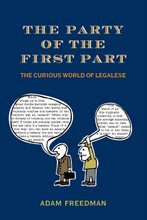
What is POFP?

Why do lawyers refer to long documents as briefs and
18-year olds as infants? Why do they use so much Latin when so few of their
clients are Ancient Romans? Is it a conspiracy?


Party of the First Part has the answers! Check out the Website for the
Legalese Hall of Shame; a glossary of legal words linked to Adam Freedman's
columns; tips on writing legal documents in plain English; and more!


Sunday, July 29, 2007

Word of the Week

In Camera

It's a Latin term, meaning "in chambers" or more generally, "in private." A judge's private office is known as his or her "chambers," as every viewer of Law & Order knows from the recurring scene in which a fed-up judge barks to the lawyers "In chambers -- now!" It's the legal equivalent of being taken to the woodshed. When the parties disagree as to the admissibility of document, the judge will often conduct an "in camera inspection" of the document, far away from the jury's gaze.

By the way, the judge's camera is related to Kodak cameras. The photographic variety is a shortened version of camera obscura -- a darkened room into which light is admitted through a double convex lens, casting an image on a suitable surface.

Friday, July 27, 2007

More Icky Words!

A Pennsylvania law firm has tried - unsuccessfully - to banish all mention of "President Bush" from an upcoming trial.

Here's the story (as reported by the Wall Street Journal Law Blog): an anti-war protestor is suing Upper Darby Township in Pennsylvania for "falsely arresting" him (whatever that means) during a Bush campaign stop in 2003. Lawyers for the Township moved to prohibit the plaintiff from mentioning President Bush during the trial - arguing that Bush's popularity rankings are so low that it would unduly prejudice the jury in favor of the plaintiff. Of course, by that logic the word "Congress" should also be banned from all courts.

Unlike the recent debacle in which "rape" and other icky words were banished from the courtroom (see here), this time the judge didn't buy it. "There is no requirement that trials be made up of the blandest theories, facts and arguments available," said Judge Gene Pratter.

Hooray for Judge Pratter. We like our language plain -- not bland.

Monday, July 23, 2007

Word of the Week

Mayhem

“Mayhem” is the act of dismembering or disfiguring another person so as to weaken his ability to defend himself. It is a medieval term (surprise!) coming from the Anglo-Norman maihem or injury. It was originally both a noun and a verb. Prosecutors would bring a charge of mayhem by stating that the defendant “feloniously did mayhem” the victim. By the latter part of the 19th Century, the verb form gave way to the closely-related maim.

One is tempted to ask: wouldn’t any dismemberment weaken one’s defenses? Well, that’s not the way the law sees it. Traditionally, it was mayhem to chop off a limb, but not an ear or a nose because, as Blackstone blandly put it, “they can be of no use in fighting.” Needless to say, lawsuits over repetitive stress injuries didn’t get very far in the Middle Ages.

The Fine Print

The Law Faculty of the University of Cape Town is about to give away valuable trade secrets. In August the university is holding intensive three-day seminars to teach lay people how to decipher legalese; or, at least, the legalese found in commercial contracts. According to South Africa's Independent Online, the course will "focus on the building blocks of legal language: the words, technical expressions, long sentences and complicated structures."

Let's hope the Law Faculty is also teaching its law students how to write in plain English, so that some day in the future consumers don't need a three-day course to read them.

Saturday, July 14, 2007

Word of the Week

Barking Dog


"Barking Dog" is defined as a dog that barks, bays, cries, howls or makes any other noise continuously and incessantly for a period of 10 minutes to the disturbance of any other person.
(Source: San Francisco Municipal Code, Art. 1, Section 41.)

Turns out, if a dog barks in the forest, and nobody hears him, then he's not a barking dog.

Friday, July 13, 2007

Rape - without all the icky words

While presiding over a rape case, Nebraska Judge Jeffre Cheuvront had the bright idea of barring attorneys and witnesses from using words including “rape,” “victim,” “assailant” and “sexual-assault kit,” and ordered witnesses to sign papers saying they wouldn’t use the words. Words such as “sex” and “intercourse” were allowed. State law allows judges to bar words or phrases that could prejudice or mislead a jury. (Story from AP).

The idea - apparently - was to prevent the use of words that would unduly prejudice the jury against the defendant. The judge's move certainly didn't do the defendant any harm -- the publicity over the restricted vocab led the judge to declare a mistrial.

Did the judge have a point? Isn't language the way to protect the defendant's rights -- is the defendant covered by things like Miranda and evidentiary rules?

Update - a Pennsylvania court recently rejected a similar attempt to banish "prejudicial" words from the courtroom. See More Icky Words!

Sunday, July 8, 2007

Word of the Week

Habeas Corpus

Habeas corpus is a writ (that is, a procedure) for challenging the legality of a prisoner’s detention. In contemporary American law, it refers to a procedure by which the constitutionality of a state conviction and imprisonment can be tested in federal court. The words literally mean “you have the body”; however, the original name for the writ was habeas corpus ad subjiciendum et recipiendum which (very) roughly translated, means, “you have the body, so bring him to court and we’ll decide whether he ought to be detained.” In old common law procedure, there were a number of “habeas corpus” writs, such as habeas corpus ad testificandum, which directed that a prisoner be deliver to a court to give evidence. The writ that we all know and love was sometimes called the Great Writ or the Writ of Liberty to distinguish it from all the others.
Like all writs, it's better with cheese on top.