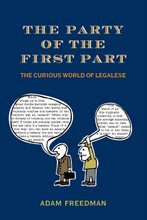
What is POFP?

Why do lawyers refer to long documents as briefs and
18-year olds as infants? Why do they use so much Latin when so few of their
clients are Ancient Romans? Is it a conspiracy?


Party of the First Part has the answers! Check out the Website for the
Legalese Hall of Shame; a glossary of legal words linked to Adam Freedman's
columns; tips on writing legal documents in plain English; and more!


Friday, September 21, 2007

And the Winners Are....


The winners of the first annual Golden Gobbledygook Award were announced last night at a special ceremony in Brooklyn, New York. Read the full story at the website.
The winners are:
  • First Place: an "Information" filed in Oklahoma State Court (featuring a 1,028 word sentence!), submitted by Paul Sherman of Virginia.

  • Second Place: a ghastly pre-nuptial agreement, submitted by a lawyer who wishes to remain anonymous.

  • Third Place: a court pleading from New Jersey Superior Court, submitted by Cynthia Covie Leese, a retired Judge who, once upon a time, actually had to wade through that pleading. She was not persuaded!

  • Dishonorable Mentions go to: Joel Wakefield; Ken Adams (of Adams Drafting); David Dickinson; and Mila Zain.

All of the Winning submissions, and the Dishonorable Mentions, are available at the Legalese Hall of Shame! Thanks to everyone who submitted entries to the contest!


Word of the Week

Blight

A noun that refers to dilapidated (usually urban) districts. Although the term has been around for years, its importance increased after the Supreme Court's 2005 decision in Kelo v. City of New London, which made clear that the federal courts would not stop local governments across the country from condemning private property for economic development. One of the most common reasons for condemnation is a finding of "blight" under state law. Different states define "blight" differently, but typically the word applies to an area in which the structures are unfit or unsafe to occupy because of defective design or construction; faulty layout or overcrowding; insufficient light, sanitation, and open space; and even economic dislocation “resulting from faulty planning” -- but then, why let the same planners have another go at the neighborhood?

Sunday, September 16, 2007

Word of the Week

Rest, Residue and Remainder

The final blast of legalese in many wills, this phrase emerged from a prolonged struggle among lawyers to find just the right words to describe the leftover bits of one’s estate.

Rest, residue and remainder has been described as a “ritual utterance” – a sort of incantation that lawyers hope will bring good luck. There is no particular technical significance to any of those words, although lawyers do occasionally take a stab at creating bogus pedigrees for them. In the eighteenth and nineteenth centuries, some courts followed the English case of Hogan v. Jackson, in which the court decided that “remainder” referred to real estate, while “residue” referred to personal property.

The phrase does evoke English law's fascination with poetic rhythm, as heard in such formulations as "the truth, the whole truth, and nothing but the truth." Anglo-Saxon law, you see, emerged from an oral tradition in which legal phrases were memorized as semi-poetic verses.

Friday, September 14, 2007

Golden Gobbledygook -- Get Those Submissions In!


The deadline for the Golden Gobbledygook award is midnight tonight (September 14th). I might show a little leeway to well-intentioned entrants who are just a teensy bit late - but hurry up and submit already!
The Golden Gobbledygook Award recognizes the best example of bad legalese.
The entries submitted so far have been fabulous. I've seen gloriously opaque pleadings, truly impenetrable contract clauses, a nonsensical pre-nuptial agreement, and a bizarre animal safety statute, among many others. Each of them is ghastly in its own special way.

Call me a masochist, but I want to see more! So submit your favorite example of exquisitely bad legalese! Post it in a comment, or email adamjfreedman@yahoo.com The Golden Gobbledygook winner will be announced on September 20th!

Tuesday, September 11, 2007

Legal Passages From India


From the Indo-Asian News Service: Indian Law Secretary T.K. Vishvanathan has made a plea for clearer legislative drafting.


In particular, Mr. Vishvanathan took aim at long-winded sentences. "Long sentences intimidate the readers, while also making the law lose its spirit," he said, adding that "present legal draftsmen too like their co-professional forefathers love to test the agility of their readers by making them leap wide gaps between the subject and the verb, and the verb and the object in the sentences written by them."


He offered an interesting theory that the tradition of lengthy sentences in statutes comes from the fact that the early parliamentary draftsmen in England had been conveyancers (and conveyancers, evidently, used particularly long sentences). Can anyone comment on this theory?


The Brief That Ate Texas

From Lowering the Bar's blog, we learn that O'Melveny & Myers has filed an appellate brief in the Fifth Circuit that is -- drum roll please -- 239 pages long. This is what happens when lawyers and word processors get together without adult supervision.

In 1908 Louis Brandeis caused a sensation when he filed a 113-page brief in Muller v. Oregon. For a time, long briefs were known as "Brandeis Briefs." Now, presumably, they'll be known as O'Melveny briefs.

Sunday, September 9, 2007

A Salt and Battery?

The AP reports that a McDonald's employee in Georgia spent a night in jail and faces misdemeanor charges for serving an over-salted hamburger. Allegedly Ms. Kendra Bull spilled salt on some hamburger meat and went ahead and cooked it anyhow. Unfortunately, one of the salty burgers was served to a member of the local constabulary.

Perhaps the most interesting linguistic feature of the case -- apart from the dilution of words like "reckless" -- is Bull's statement that, after she spilled the salt, a co-worker "tried to thump the salt off." Thumped?