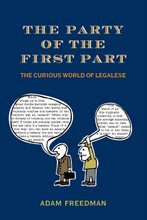
What is POFP?

Why do lawyers refer to long documents as briefs and
18-year olds as infants? Why do they use so much Latin when so few of their
clients are Ancient Romans? Is it a conspiracy?


Party of the First Part has the answers! Check out the Website for the
Legalese Hall of Shame; a glossary of legal words linked to Adam Freedman's
columns; tips on writing legal documents in plain English; and more!


Saturday, September 29, 2007

Word of the Week

ss

Not exactly a word, granted, but an abbreviation typically found at the beginning of an affidavit or other sworn statement, when listing the venue of the affidavit: "State of New York, County of New York: ss."

Unfortunately nobody can remember exactly what those two little letters stand for. They come from an old system of Latin notation known as “court hand," so it's safe to say that they stand for something in Latin. The abbreviation is sometimes said to be short for scilicet (one may know); but other suggestions include subscripsi, sans, sacerdotes, sanctissimus, Spiritus Sanctus, and sunt. Black’s Law Dictionary will only go so far as to say that it is “commonly . . . supposed to be a contraction of ‘scilicet’.” And yet, no self-respecting lawyer will draft an affidavit without it.

Poetry on the Bench


U.S. District Court Judge James Muirhead rejected a prisoner's exhibit in a decision written entirely in poetic verse. To be exact, a decision written in the style of Dr. Seuss' "Green Eggs and Ham."


NY Lawyer reports that an inmate sent the egg as part of his complaint against New Hampshire state officials. The inmate, Charles Wolff, 61, says, among other things, that he cannot tolerate hard-boiled eggs, so when he was served a meal with them, he mailed the complaint and egg to court in a manila envelope.


Judge Muirhead wrote: "I do not like eggs in the file. I do not like them in any style. I will not take them fried or boiled. I will not take them poached or broiled. I will not take them soft or scrambled Despite an argument well-rambled." He then ordered the egg destroyed: "No fan I am Of the egg at hand. Destroy that egg! Today! Today! Today I say! Without delay!"


Muirhead actually follows a noble tradition of poetry on the bench. In 1983, for example, a Michigan court rejected a lawsuit brought on behalf of a tree -- the panel's dismissal consisted of 12 lines of verse modeled on Joyce Kilmer's famous poem "Trees." It began:

We thought that we would never see/ A suit to compensate a tree.


Wednesday, September 26, 2007

Until death . . . and then some

All eyes on the New Jersey Supreme Court as they weigh in on the meaning of that oh-so-controversial word: "spouse."

Here's the question: is a widower still a "spouse?"

The New York Post reports on the long-running battle over the estate of Johnson & Johnson heir John Seward Johnson, Jr., who established a trust in 1961 for the benefit of his children and grandchildren and their "spouses." Broadway producer Marty Richards was married to one of those children -- Mary Lee Johnson -- until Mary Lee's death in 199o. Despite Mary's death, Richards claims that he is still a "spouse" within the meaning of the trust.

In 1996, a Superior Court judge ruled against Richards, holding that widowers don't count as "spouses." But then an appellate court reversed, ruling that widows remain spouses, although divorcees do not. As they say on Broadway: on with the show!

Full text Gobbledygook

By popular demand, I've now posted the full 38-page "Information" that won First Place in the Golden Gobbledygook Award. Go the Legalese Hall of Shame, and where you see the First Place Golden Gobbledygook entry, follow the link to the winning document!

Friday, September 21, 2007

And the Winners Are....


The winners of the first annual Golden Gobbledygook Award were announced last night at a special ceremony in Brooklyn, New York. Read the full story at the website.
The winners are:
  • First Place: an "Information" filed in Oklahoma State Court (featuring a 1,028 word sentence!), submitted by Paul Sherman of Virginia.

  • Second Place: a ghastly pre-nuptial agreement, submitted by a lawyer who wishes to remain anonymous.

  • Third Place: a court pleading from New Jersey Superior Court, submitted by Cynthia Covie Leese, a retired Judge who, once upon a time, actually had to wade through that pleading. She was not persuaded!

  • Dishonorable Mentions go to: Joel Wakefield; Ken Adams (of Adams Drafting); David Dickinson; and Mila Zain.

All of the Winning submissions, and the Dishonorable Mentions, are available at the Legalese Hall of Shame! Thanks to everyone who submitted entries to the contest!


Word of the Week

Blight

A noun that refers to dilapidated (usually urban) districts. Although the term has been around for years, its importance increased after the Supreme Court's 2005 decision in Kelo v. City of New London, which made clear that the federal courts would not stop local governments across the country from condemning private property for economic development. One of the most common reasons for condemnation is a finding of "blight" under state law. Different states define "blight" differently, but typically the word applies to an area in which the structures are unfit or unsafe to occupy because of defective design or construction; faulty layout or overcrowding; insufficient light, sanitation, and open space; and even economic dislocation “resulting from faulty planning” -- but then, why let the same planners have another go at the neighborhood?

Sunday, September 16, 2007

Word of the Week

Rest, Residue and Remainder

The final blast of legalese in many wills, this phrase emerged from a prolonged struggle among lawyers to find just the right words to describe the leftover bits of one’s estate.

Rest, residue and remainder has been described as a “ritual utterance” – a sort of incantation that lawyers hope will bring good luck. There is no particular technical significance to any of those words, although lawyers do occasionally take a stab at creating bogus pedigrees for them. In the eighteenth and nineteenth centuries, some courts followed the English case of Hogan v. Jackson, in which the court decided that “remainder” referred to real estate, while “residue” referred to personal property.

The phrase does evoke English law's fascination with poetic rhythm, as heard in such formulations as "the truth, the whole truth, and nothing but the truth." Anglo-Saxon law, you see, emerged from an oral tradition in which legal phrases were memorized as semi-poetic verses.