Ray Ward of the (new) legal writer blog, has posted a chapter that he wrote for the book A Defense Lawyer’s Guide to Appellate Practice. The chapter is called Style and it has great suggestions for improving one's writing. Ray takes aim at some of the classic monsters of legalese (doublets and triplets), but also points out the litigator's tendency toward hyperbole (using terms like "indisputably" when the other side is disputing it).
Thanks to the Manage Your Writing site for pointing this out.
Sunday, September 9, 2007


Saturday, September 8, 2007
POFP Podcasts!
There's a new Party of the First Part podcasts!
This week's topic is "Trespassers will be Prosecuted." There'll be a new podcast each week for the next six weeks. You can listen for free at any of the following venues:
iTunes, click here.
Pod-Planet, click here.
Podfeed, click here.
Podcast Alley, click here.
Odeo, click here.
This week's topic is "Trespassers will be Prosecuted." There'll be a new podcast each week for the next six weeks. You can listen for free at any of the following venues:
iTunes, click here.
Pod-Planet, click here.
Podfeed, click here.
Podcast Alley, click here.
Odeo, click here.
It even has theme music . . . . enjoy!
Word of the Week
Prurient Interest
This phrase is part of the current legal test for obscenity: material is said to be obscene if it "appeals to a prurient interest." A prurient interest is defined as "an unacceptable interest in sex." Unacceptable to whom?, one might ask. The answer is: to the judge or jury in a particular case. Oh well, the word comes from the Latin purire, meaning "to itch," and thus has the sense of an itching or burning desire.
Ever since the sub-prime debacle, the Prurient Interest rate has gone up to almost 5 percent.
Thursday, September 6, 2007
What? Sharking is a Verb?
According to an Associated Press story, a federal court jury considering the biggest Chicago mob trial in years has asked for an English language dictionary.
The jurors say they don't want to look up legal terms. They say they just want to check common definitions of English words. Federal Judge James Zagel told defense attorneys and prosecutors that he prefers not to send jurors the dictionary. He'll instead ask the jury to give him a list of the words they want defined.
Why the reluctance to give the jurors a dictionary? True, dictionaries may give multifaceted and confusing definitions, but if we trust jurors to sift through ballistic evidence, why can't we trust them to navigate Websters? Heaven knows, but judges are notoriously reluctant to define terms for the perpetually-confused jury members. Peter Tiersma has chronicled some of the worst abuses of enforced jury ignorance (like refusing to explain to jurors what aggravating and mitigating mean) in his book Legal Langauge. And I discuss the "language barrier" faced by jurors in this column.
The jurors say they don't want to look up legal terms. They say they just want to check common definitions of English words. Federal Judge James Zagel told defense attorneys and prosecutors that he prefers not to send jurors the dictionary. He'll instead ask the jury to give him a list of the words they want defined.
Why the reluctance to give the jurors a dictionary? True, dictionaries may give multifaceted and confusing definitions, but if we trust jurors to sift through ballistic evidence, why can't we trust them to navigate Websters? Heaven knows, but judges are notoriously reluctant to define terms for the perpetually-confused jury members. Peter Tiersma has chronicled some of the worst abuses of enforced jury ignorance (like refusing to explain to jurors what aggravating and mitigating mean) in his book Legal Langauge. And I discuss the "language barrier" faced by jurors in this column.
Tuesday, September 4, 2007
Golden Gobbledygook Sweeps The Nation!
Thanks to the following blog-meisters for promoting the Golden Gobbledygook Award:
The entries are starting to come in... there are some great examples of bad legalese, but at this point, the competition is wide open. So submit your favorite example of exquisitely bad legalese! Post it in a comment, or email adamjfreedman@yahoo.com
Now Comes The Book
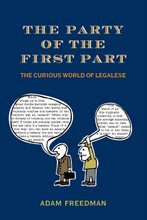
September 4th (today!) is the official publication day of The Party of the First Part. Already, our spies have reported seeing the book on shelves at Barnes & Noble on the Upper West Side . . . So cast off your boilerplate; march into your nearest bookstore, and demand The Party of the First Part -- in plain English.
- The Amazon page is here;
- Barnes & Noble here;
- Powell's books, here;
- Also, the book will soon be available via thebillablehour.com.
ENJOY!!
Saturday, September 1, 2007
Word of the Week
Nuisance
One of the oldest torts, a nuisance is any condition or activity that interferes with a person's "quiet enjoyment" of his or her property. The word comes from the Latin nocere (to hurt), from which we get such related words as annoyance, noise, and noxious. A public nuisance is an unreasonable interference with the public's health, safety, peace or convenience.
The doctrine of nuisance gives rise to the delightfully oxymoronic attractive nuisance, refers to dangerous conditions that might be positively inviting to certain people (think children wandering on to a construction site). Attractive nuisance is sort of like "willful negligence" -- only lawyers could come up with these terms.
Subscribe to:
Posts (Atom)