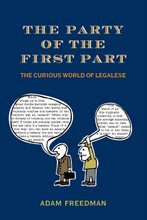
What is POFP?

Why do lawyers refer to long documents as briefs and
18-year olds as infants? Why do they use so much Latin when so few of their
clients are Ancient Romans? Is it a conspiracy?


Party of the First Part has the answers! Check out the Website for the
Legalese Hall of Shame; a glossary of legal words linked to Adam Freedman's
columns; tips on writing legal documents in plain English; and more!


Sunday, May 27, 2007

Word of the Week

Choate
Choate has become a legal term of art, as seen in the "choate lien doctrine." The only problem -- now how can I put this? -- is that choate is an utterly nonsensical word. The word “inchoate” exists, sure: it comes from the Latin incohatus or “incomplete.” In the early 1900's, lawyers, assuming that choate must be the opposite of inchoate, started using "choate" to refer to things that are complete, like a fully perfected lien. But actually, the "in" of inchoate is more like the "in" of inebriated. The Oxford English Dictionary refers to choate as "an erroneous word, framed to mean ‘finished’, ‘complete’, as if the in- of inchoate were the Latin negative." For more on Legal Latin, see my February 03 column.
In the meantime, if you drive, make sure to stay ebriated.

Saturday, May 26, 2007

The $6 Million Lease

A Philadelphia court slapped a $6.6 million award against a local lawyer who drafted a commercial lease so poorly that it amounted to malpractice. According to the judge, the lease agreement was "inartfully written and done so in a confusing fashion, which lends itself to ambiguities and disagreements." Read more at law.com.

Saturday, May 19, 2007

Word of the Week

Appurtenance

Never buy a house if you can buy a house and its appurtenances. Appurtenance is legalese for "a thing connected to something else." How's that for precision? In fact, you could substitute the word "thing" for appurtenance in most sentences without any loss of meaning. In the context of that house purchase, an "appurtenance" would be things like fixtures that go along with the house.

The word comes from Anglo-French apurtenance, and ultimately from the Latin appertinire ("to belong"). As the Latin root suggests, an appurtenance was originally a right that belonged to some other property or position. Hence the phrase "the rights and privileges appurtenant thereto." We're all connected, but we're not all appurtenant.

Friday, May 18, 2007

What can Browne do for you?

When the subject is dishonesty, lawyers are never at a loss for words – just ask Lord Browne, the former chief executive of BP. Browne, who admittedly gave an “untruthful account” to a British court, now faces the threat of perjury charges in the UK. He also faces a motion for contempt in Texas stemming from allegedly misleading statements that he made in a BP-related litigation.

Perjury and contempt are just two of the many legal terms to describe fibbing. In Black’s Law Dictionary, the entry for false includes a list of twenty-one synonyms, including such stalwarts as false representations, misrepresentations, frauds and deceits, counterfeits and forgeries. The one word you won't fine in Black's is good 0ld-fashioned lying. For more on the many legal euphemisms for lying, read my column.

Sunday, May 13, 2007

A Horse is a Horse?


Does the term "close family members" include pets?


Of course it does -- just ask Toby the Talking Horse, or your nearest plaintiff's lawyer. Apparently animal rights activists and trial lawyers are trying to get damages for "emotional distress" suffered by pet owners who lost their furry companions due to the tainted pet food scandal.


The problem is that "emotional distress" damages are usually limited to those who suffer the loss of a "close family member" -- hence the move to redefine pets as being on the same level as brothers and sisters (of course, they're superior).


Strictly speaking, the law classifies pets as chattels, which is why one can buy and sell dogs, but not siblings. But the animal rights movement has inspired a linguistic revolution as well: cities such as Berkeley and West Hollywood in California; Boulder, Colorado; and Amherst, Massachusetts have abolished the term "pet owners" and now refer to such people as "guardians."
For more on the status of animals in law (and legal language) see my December 2004 Column, Legal Beagles.

Sunday, May 6, 2007

Luck be a lady


Apparently, a number of academics have jumped on the bandwagon to define "poker" as being a game of "skill" rather than a game of "chance." There's big money at stake, as it were, since the status of poker affects not only casino gambling, but the huge online gaming industry as well. Back in September, Congress barred online wagers on any "game predominately subject to chance."


The Wall Street Journal reports that Harvard Law Professor Charles Nesson recently convened a meeting of academics and poker buffs to strategize on ways to get poker defined as a game of skill. In one 1989 California Circuit Court decision, the court held that poker is a game of skill, but the case law is constantly evolving -- where it stops, nobody knows.


Clearly poker involves skill (just try keeping a poker face), but is it more skill than luck? The traditional definition of gambling recognizes the element of skill. Black's Law Dictionary says that gambling occurs "where there is a chance for profit if a player is skillful and lucky."


As for poker, the word is thought to derive from poque, which was an archaic French bluffing game. But is bluffing a matter of luck, or skill?

Sunday, April 29, 2007

Defining Torture

It's murder coming up with a definition of torture -- or is the other way around?

New York Lawyer reports that Professor John Yoo (co-author of the infamous 2002 "torture memo") came to New York last week to defend his position that nothing short of "organ failure or . . . death" constitutes torture of alleged al Qaeda operatives by U.S. military interrogators.

Is he right? The criminal law that codifies the Convention Against Torture defines torture as "an act committed by a person acting under color of law specifically intended to inflict severe physical or mental pain or suffering (other than pain or suffering incidental to lawful sanctions) upon another person within his custody or physical control." At the very least, the bit about "mental" suffering seems to be broader -- assuming, of course, that al Qaeda operatives fall under the Convention's protections.

According to Stroud's Judicial Dictionary, no terrorist would be subject to torture. Stroud's entry for "torture" says simply "see Cruelty to Animals."

To be fair, Yoo's definition seems closer to the traditional idea of torture. Shumaker's Cyclopedic Dictionary of Law (1922) defines it as "Bodily pain or hurt inflicted with the object of compelling a disclosure of guilt or of knowledge in respect of a crime or its perpetrator. It was imposed by various means, and under sanction of law."

The Oxford English Dictionary defines "judicial torture" as "infliction of severe bodily pain, . . ., inflicted by a judicial or quasi-judicial authority, for the purpose of forcing an accused or suspected person to confess, or an unwilling witness to give evidence or information."

Incidentally, "torture" comes from the Latin root torquere (to twist), from which we get such useful words as torsion, torque -- and, of course, tort.