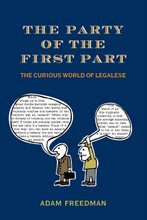
What is POFP?

Why do lawyers refer to long documents as briefs and
18-year olds as infants? Why do they use so much Latin when so few of their
clients are Ancient Romans? Is it a conspiracy?


Party of the First Part has the answers! Check out the Website for the
Legalese Hall of Shame; a glossary of legal words linked to Adam Freedman's
columns; tips on writing legal documents in plain English; and more!


Friday, April 25, 2008

Word of the Week

Dotards

Dead or decayed trees that cannot be used for timber. They are distinguished from windfalls - trees and their fruits that are blown down by the wind. A tenant for life may cut down dotards, but does not get the windfalls. (See L.B. Curzon, Dictionary of the Law).

Sunday, April 13, 2008

La Loi Dans Le Yukon, eh?


A small claims case over C$13,000 will end up costing Canadian taxpayers over ten times that amount -- all because of a violation of "language rights."

The defendant, who owns a bed & breakfast, was originally held liable for unpaid bills to a local construction firm in the Whitehorse area of the Yukon. But the Yukon Court of Appeal vacated the judgment because the defendant (a francophone) was not given the opportunity to defend himself in French, as Canada's language laws require. The Court ordered the provincial government to pay C$143,000 to the parties and lawyers for their expenses in litigating this weighty issue.

Word of the Week

Venireman

A prospective juror -- before becoming an actual juror, the venireman must pass the voir dire examination.

The word derives from the ancient writ of Venire Facias Juratores, literally, "to make the jurors come" -- it was an order to the sheriff to summon a jury (venire is Latin for "to come"). The writ was sometimes known simply as Venire Facias, or even just Venire.

Sunday, April 6, 2008

Word of the Week

Turntable Doctrine

Also known as "attractive nuisance" (one of the law's great oxymorons) -- this doctrine holds that the owner of premises must not keep unguarded machinery or other items that might attract or lure children into hurting themselves. If a child does wander on to the property and end up with injuries, the owner cannot argue that the kid was trespassing: the attractiveness of the machinery/structure amounts to an implied invitation to enter.

According to Black's Law Dictionary, the name comes from "the dangerous and alluring qualities of a railroad turntable."

Wassup?

And I think we all know what that means.

Or do we? Maryland's Court of Special Appeals recently had to consider the question of whether the term "What's up?" -- when uttered by a policeman -- constitutes a greeting, or an interrogation. The issue arose in the criminal trial of one Maurice Prioleau. Shortly after Mr. Prioleau was arrested for drug possession, a Baltimore cop addressed him by saying "What's up, Maurice?" -- to which Mr. Prioleau gave an incriminating response.

Prioleau's lawyers argued that "what's up?" amounts to a police interrogation and, therefore, that Maurice should have been given a Miranda warning before he answered. Granted, the question mark sure makes it look interrogatory, but the court sided with police, stating:

"The phrase 'what's up?' is commonly used as a greeting, especially, as the State
points out, among young people."

Saturday, March 15, 2008

Word of the Week


Spitzerfreude


Okay, not exactly a legal word but very close. It's what they call a "portmanteau" word, that is a merger of two existing words -- like, say, advertorial. It's a blend of Elliot Spitzer and schadenfreude, the splendid German word meaning "malicious enjoyment in the misfortune of others." Spitzerfreude (sometimes spelled Spitzenfreude) is defined as "malicious enjoyment in the misfortune of Client 9."


Meanwhile, as speculation mounts that Spitzer might plead to a Mann Act violation, it's worth noting that the original name of the statute was the "Mann White Slave Trade Traffic Act" -- "white slavery" being a nineteenth century term for the act of forcing young women in prostitution.

Saturday, March 8, 2008

Word of the Week

Goods and Chattels

It's one of those phrases with legal overtones but no clear definition. Traditionally, the phrase is taken to refer to every type of personal property except a freehold title. It can even include interests in land, such a lease.

"Good" is an English word, related to the Old Norse gothr. "Chattel" comes from the Old French chatel, and ultimately from the Latin catalla, which literally means cattle. Somehow, the French came to use "cattle" to refer to any moveable good; which is an odd usage, given that cattle are notoriously difficult to move. Medieval "law French" pleadings from England refer to "biens et chateaux." As so often happened with these old expressions, English lawyers decided to translate half of the phrase (thus changing biens to good), but leaving the other half foreign.

Shakespeare, who as I have commented elsewhere, knew his law, has the character Petruchio (Taming of the Shrew) exclaim: "I will be master of what is mine own. She is my goods, my chattels, she is my house."