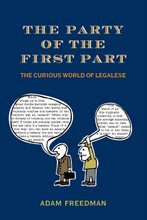
What is POFP?

Why do lawyers refer to long documents as briefs and
18-year olds as infants? Why do they use so much Latin when so few of their
clients are Ancient Romans? Is it a conspiracy?


Party of the First Part has the answers! Check out the Website for the
Legalese Hall of Shame; a glossary of legal words linked to Adam Freedman's
columns; tips on writing legal documents in plain English; and more!


Saturday, September 27, 2008

New Entries in the Hall of Shame

Two new entries for the Legalese Hall of Shame in our related website.
  • From attorney Erin Engels, a baffling sentence from a retirement agreement. The lawyer used 150 words to say "Retiree waives his right to sue the employer." But why just "waive" a right when you can "release, remit, remise, acquit and forever discharge " a right? It's hard work, but then this was a union job.
  • From concerned citizen Howard Kline, an Ohio traffic ordinance that requires a GPS unit to navigate your way through the dangling modifiers.

In our never-ending quest to reform legal language, we've exposed these (and other) examples of bad legalese to public ridicule. Check them out at the Hall of Shame!

Sunday, September 7, 2008

A Fabulous Book for Language Lovers


Hot off the presses! A new collection of essays from The Vocabula Review -- an online journal devoted to battling nonstandard, careless English, while also celebrating the opulence and elegance of the English language.

The book is called: Vocabula Bound 2: Our Wresting, Writhing Tongue (the subtitle comes from a quotation by Ben Johnson). It is a collection of twenty-eight essays about the English language, as well as ten poems, that originally appeared in The Vocabula Review. Included within its covers are essays by Joseph Epstein, Judge Mark Painter, and -- yours truly.


You can order Vocabula Bound 2 from Vocabula Books or Amazon. It's also worth checking out Vocabula Review for the pleasure of reading its fascinating content.

Word of the Week


Admixed Embryo

Wired Magazine reports that Admixed Embryo is "legalese for any early-stage embryo combining human and nonhuman genes or tissue. Encompassing both cybrids and chimeras yet sounding less apocalyptic than either, these hybrids are now approved in England for stem cell research."

Monday, September 1, 2008

Word of the Week

Coparcenary

Co-ownership of property by two or more individuals who inherited it jointly under the laws of intestate succession. The word derives from the Anglo-Norman parcenerie and Old French parsonerie, both meaning "partnership."

Sunday, August 24, 2008

Word of the Week

Mischief Rule

A method of interpreting statutes, which involves asking "what was the mischief that this statute was meant to remedy?" The answer to this question will reveal the underlying purpose of the statute, which should guide all interpretation. And besides, inquiring minds want to know.

Sunday, August 17, 2008

Word of the Week

Boycott
A boycott is a concerted effort to refrain from buying from, selling to, or working for, some company or other organization. Some types of boycotts are illegal.

The term entered the language in 1880, thanks to Captain Charles Boycott, who was the estate agent for the Earl Erne in County Mayo, Ireland. The Earl's tenants demanded that Boycott reduce their rents and when he refused -- and began evicting tenants -- everyone in the locality agreed to stop dealing with him. Unable to find workers for the Earl's fields, or tradespeople from whom to purchase necessities, Captain Boycott eventually moved to England to pursue other opportunities, as they say. But his name had already become famous. By November 1880, the Times of London used "boycott" as a verb. The rest is history.

Oh Kannada!

According to OutlookIndia, a legal battle is brewing over the status of the Kannada language of India. Not whether Kannada is an "official" language of India (it already is), but whether Kannada deserves to be recognized as a "classical" language.

A constitutional decree in 2004 created a new category of languages in India -- languages that met certain requirements could be accorded the status of a 'classical language.' Tamil and, a year later, Sanskrit, have been accorded the status. But so far, Kannada has not.

On the off-chance you're not familiar with it, Kannada is one of the major Dravidian languages of India, spoken in the southern state of Karnataka. Karnataka activists have blocked an express train for 20 minutes to agitate for classical status, and they've promised to take the issue up to the Supreme Court if they don't get their way.

So if a group of ancient Romans blocks a train in your neighborhood, don't be alarmed; they're probably just agitating to get more respect for Latin.