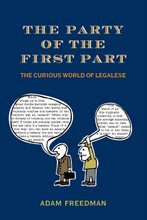
Last Saturday (August 9) was the annual luncheon for Scribes, the American Society of Legal Writers. This was the first Scribes luncheon I had attended and it was great fun -- an entire roomful of law-and-language nerds! What could be better?
The guest of honor was Justice Antonin Scalia, who received the Scribes Lifetime Achievement Award. Justice Scalia gave a characteristically lively acceptance speech. Both Scalia and Bryan Garner stayed after the lunch to sign copies of the book they've just written together: Making Your Case: The Art of Persuading Judges.
Also in attendance was the indefatigable Lisa Solomon, whose website, The Billable Hour (www.thebillablehour.com), is a great source for all things legal (including, ahem, my book). And Scribes Executive Director, Joe Kimble, was there with copies of his lucid book, Lifting the Fog of Legalese.
If you want to know more about Scribes, check out their website www.scribes.org.
Monday, August 11, 2008


Word of the Week
Robbery
Robbery is a theft committed in the presence of the victim -- a hold up. As the legal lexicographer John Cowell wrote in 1607:
Robberie commeth from the French, and in our common lawe [signifies] a
felonious taking away of another mans goods from his person or presence, against
his will, putting him in feare, and of purpose to steal the same goods.
Highway robbery was, at first, not a metaphor, but a technical offense -- a robbery committed on the King's highway, and it carried a heavier sentence.
Saturday, July 19, 2008
Word of the Week
Sua Sponte
Latin. Of its (his, her, their) own accord. This term refers to action taken by a court without being asked to do so by a party, e.g., The court dismissed the claim sua sponte.
Occasionally pronounced (at least by lawyers at my old firm) as "sua spumoni," which of course means "of his own Italian ice cream." Which reminds me, National Spumoni Day is coming up soon -- August 21!
Sunday, June 29, 2008
Word of the Week
To Bear Arms
This has to be the phrase of the week -- perhaps of the year. Depending on which side of the gun rack you stand, "to bear arms" is:
- a plain English term, meaning "to carry weapons";
- an idiomatic phrase, used by the Founding Fathers to convey "military service"; or
- a mistaken spelling of "bare arms" (because the Founders wanted Minutemen to show off their muscles).
Read my full commentary in the next post -- soon to be published (in slightly different versions) in New York Law Journal Magazine and Vocabula Review.
The DC Gun Case: Loaded Words
On June 26, the Supreme Court fired off its decision in DC v. Heller, holding that the Second Amendment confers an individual right to possess firearms, unconnected to military service.
The Heller case – long anticipated as the Court’s first-ever comprehensive interpretation of the right “to keep and bear arms” – generated an astounding 67 amicus curiae (“friend of the court”) briefs. But of those 67 briefs, the only one cited by both the majority and dissenting opinions was one submitted by a group of professors of linguistics and English, the so-called “Linguists’ Brief.”
These language scholars took center stage because of the dearth of judicial precedent on the Second Amendment. In the absence of helpful prior decisions, the Court had to start from scratch in decoding the “original meaning” of the Amendment. While various briefs cited founding-era dictionaries, only the Linguists devoted their entire brief to the niceties of eighteenth century grammar and usage.
That may seem like a lot of fuss for a single sentence – but then, this is no ordinary sentence. The Second Amendment says:
You will immediately notice that the sentence has two parts, a “prefatory” clause (the bit ending in “State”), and an “operative” clause (everything after “State”). The relationship between those two clauses has bedeviled scholars for years. Gun control advocates say that the prefatory clause limits the scope of the amendment to militia members, while their opponents claim that the operative clause creates an individual right to bear arms that cannot be fettered by the preface. Unfortunately, there is nowhere else in the Constitution to look for guidance: the Second Amendment’s prefatory clause is the only one of its kind in that document.
The Linguists tell us that the prefatory clause of the Second Amendment is what’s known as an “absolute clause,” that is, an adverbial phrase that is separate from the main clause of the sentence. Such clauses are called “absolute” because they are grammatically independent from the rest of the sentence – no word in the absolute clause can be said to modify any particular word in the main clause.
On the strength of that grammatical autonomy, some gun enthusiasts argued that the prefatory clause has no impact whatsoever on the operative clause. George Mason Law Professor Nelson Lund, for example, wrote in an academic paper that “the Second Amendment has exactly the same meaning that it would have if the preamble [i.e., prefatory clause] had been omitted.”
The Linguists attacked Lund’s assertion with a fusillade of grammar books demonstrating that an absolute clause, while grammatically distinct, “add[s] meaning to the entire sentence.” The Linguists’ point can be seen in an absolute construction that is still in common use: “weather permitting, I will go for a walk.” In that sentence, “weather permitting” is the absolute clause (tip – such clauses typically involve verbs ending in “-ing”). The main clause stands on its own grammatically, but the absolute clause modifies the speaker’s intention to go for a walk.
The Second Amendment’s absolute clause, according to the Linguists, expresses a causal connection; namely “because a well regulated militia is necessary to the security of a free state, the right of the people to keep and bear arms shall not be infringed.” Justice Antonin Scalia, writing for the majority, readily concedes that there is a logical link between the two halves of the sentence, but he argues that the prefatory clause merely announces a purpose of the operative clause, not the purpose (other purposes of gun ownership include hunting and self-defense). On this reading, the Second Amendment is really about allowing individuals to own guns, the fact that this right happens to bolster the militia is simply an added plus.
And then there is the operative clause’s guarantee of a right “to keep and bear Arms.” Neither side is entirely happy with that phrase. The majority opinion focuses on the straightforward word “keep” while the dissent spends most of its time on the more complicated “bear.”
“Keep” has much the same meaning as it did in 1773, when Samuel Johnson defined it as “[t]o retain; not to lose,” and “[t]o have in custody.” Standing alone, the right “to keep arms” suggests an individual right to have a gun in your house – preferably locked in a child-proof drawer, but an individual right all the same.
The Founders, however, did not create a stand-alone right to “keep arms,” they joined it with the right “to bear arms.” In the High Court, the battle over the Second Amendment’s operative clause came down to the question of whether “bear arms” must be understood in an idiomatic or non-idiomatic sense. An idiom is an expression that is peculiar to a language (from Latin idioma, “peculiarity”), and which conveys a meaning different from its literal or logical signification.
The dissent argues that in the eighteenth century, “bear arms” was an idiomatic expression meaning “to perform military service,” thus emphasizing the martial purpose of the amendment. Among the many examples quoted in the Linguists’ Brief is the Declaration of Independence, which denounces King George for forcing American colonists “to bear Arms against their country.” The Linguists also cite an academic survey of newspapers, books, and pamphlets from the founding era: of 115 texts using the term “bear arms,” all but five did so in a military context.
Further supporting the dissenters’ interpretation, the Linguists demonstrated that the word “arms,” even without the “bear,” had an overwhelmingly military connotation in the late eighteenth century. In his 1794 treatise, The Distinction Between Words Esteemed Synonymous in the English Language, John Trusler distinguishes “arms” from “weapons,” stating that the former are “instruments of offence generally made use of in war.” Based on the evidence, one is tempted to agree with Yale professor Akhil Amar that “the Framers [of the Second Amendment] envisioned Minutemen bearing guns, not Daniel Boone gunning bears.”
And yet, Justice Scalia was having none of it. He rather ingeniously contends that the idiomatic sense of “bear arms” only existed when those words were followed by the preposition “against.” It’s not clear where Scalia got that argument – The Complete Idiom’s Guide to the Second Amendment ? – but it allows him to conclude that the Founders intended “bear arms” in the non-idiomatic sense of “to carry arms.” In other words, you have right to your gun, whether or not you join the militia. As the majority spokesman, Scalia had the last word, a fact that may have left the much-cited Linguists feeling as though they had been shooting blanks.
The Heller case – long anticipated as the Court’s first-ever comprehensive interpretation of the right “to keep and bear arms” – generated an astounding 67 amicus curiae (“friend of the court”) briefs. But of those 67 briefs, the only one cited by both the majority and dissenting opinions was one submitted by a group of professors of linguistics and English, the so-called “Linguists’ Brief.”
These language scholars took center stage because of the dearth of judicial precedent on the Second Amendment. In the absence of helpful prior decisions, the Court had to start from scratch in decoding the “original meaning” of the Amendment. While various briefs cited founding-era dictionaries, only the Linguists devoted their entire brief to the niceties of eighteenth century grammar and usage.
That may seem like a lot of fuss for a single sentence – but then, this is no ordinary sentence. The Second Amendment says:
A well regulated Militia, being necessary to the security of a free State, the right of the people to keep and bear Arms, shall not be infringed.
You will immediately notice that the sentence has two parts, a “prefatory” clause (the bit ending in “State”), and an “operative” clause (everything after “State”). The relationship between those two clauses has bedeviled scholars for years. Gun control advocates say that the prefatory clause limits the scope of the amendment to militia members, while their opponents claim that the operative clause creates an individual right to bear arms that cannot be fettered by the preface. Unfortunately, there is nowhere else in the Constitution to look for guidance: the Second Amendment’s prefatory clause is the only one of its kind in that document.
The Linguists tell us that the prefatory clause of the Second Amendment is what’s known as an “absolute clause,” that is, an adverbial phrase that is separate from the main clause of the sentence. Such clauses are called “absolute” because they are grammatically independent from the rest of the sentence – no word in the absolute clause can be said to modify any particular word in the main clause.
On the strength of that grammatical autonomy, some gun enthusiasts argued that the prefatory clause has no impact whatsoever on the operative clause. George Mason Law Professor Nelson Lund, for example, wrote in an academic paper that “the Second Amendment has exactly the same meaning that it would have if the preamble [i.e., prefatory clause] had been omitted.”
The Linguists attacked Lund’s assertion with a fusillade of grammar books demonstrating that an absolute clause, while grammatically distinct, “add[s] meaning to the entire sentence.” The Linguists’ point can be seen in an absolute construction that is still in common use: “weather permitting, I will go for a walk.” In that sentence, “weather permitting” is the absolute clause (tip – such clauses typically involve verbs ending in “-ing”). The main clause stands on its own grammatically, but the absolute clause modifies the speaker’s intention to go for a walk.
The Second Amendment’s absolute clause, according to the Linguists, expresses a causal connection; namely “because a well regulated militia is necessary to the security of a free state, the right of the people to keep and bear arms shall not be infringed.” Justice Antonin Scalia, writing for the majority, readily concedes that there is a logical link between the two halves of the sentence, but he argues that the prefatory clause merely announces a purpose of the operative clause, not the purpose (other purposes of gun ownership include hunting and self-defense). On this reading, the Second Amendment is really about allowing individuals to own guns, the fact that this right happens to bolster the militia is simply an added plus.
And then there is the operative clause’s guarantee of a right “to keep and bear Arms.” Neither side is entirely happy with that phrase. The majority opinion focuses on the straightforward word “keep” while the dissent spends most of its time on the more complicated “bear.”
“Keep” has much the same meaning as it did in 1773, when Samuel Johnson defined it as “[t]o retain; not to lose,” and “[t]o have in custody.” Standing alone, the right “to keep arms” suggests an individual right to have a gun in your house – preferably locked in a child-proof drawer, but an individual right all the same.
The Founders, however, did not create a stand-alone right to “keep arms,” they joined it with the right “to bear arms.” In the High Court, the battle over the Second Amendment’s operative clause came down to the question of whether “bear arms” must be understood in an idiomatic or non-idiomatic sense. An idiom is an expression that is peculiar to a language (from Latin idioma, “peculiarity”), and which conveys a meaning different from its literal or logical signification.
The dissent argues that in the eighteenth century, “bear arms” was an idiomatic expression meaning “to perform military service,” thus emphasizing the martial purpose of the amendment. Among the many examples quoted in the Linguists’ Brief is the Declaration of Independence, which denounces King George for forcing American colonists “to bear Arms against their country.” The Linguists also cite an academic survey of newspapers, books, and pamphlets from the founding era: of 115 texts using the term “bear arms,” all but five did so in a military context.
Further supporting the dissenters’ interpretation, the Linguists demonstrated that the word “arms,” even without the “bear,” had an overwhelmingly military connotation in the late eighteenth century. In his 1794 treatise, The Distinction Between Words Esteemed Synonymous in the English Language, John Trusler distinguishes “arms” from “weapons,” stating that the former are “instruments of offence generally made use of in war.” Based on the evidence, one is tempted to agree with Yale professor Akhil Amar that “the Framers [of the Second Amendment] envisioned Minutemen bearing guns, not Daniel Boone gunning bears.”
And yet, Justice Scalia was having none of it. He rather ingeniously contends that the idiomatic sense of “bear arms” only existed when those words were followed by the preposition “against.” It’s not clear where Scalia got that argument – The Complete Idiom’s Guide to the Second Amendment ? – but it allows him to conclude that the Founders intended “bear arms” in the non-idiomatic sense of “to carry arms.” In other words, you have right to your gun, whether or not you join the militia. As the majority spokesman, Scalia had the last word, a fact that may have left the much-cited Linguists feeling as though they had been shooting blanks.
Monday, May 26, 2008
Work, Work, Work
In the case of Tyson Foods, Inc. v. de Ascencio, the Supreme Court is currently considering the issue of whether the word "work" under the Fair Labor Standards Act includes the time spent donning light protective gear, "if the activities do not require a significant level of exertion." Read the rest at Scotus Blog. All I can say is: if doing work requires a "significant level of exertion," then I want no part of it.
Sunday, May 11, 2008
Word of the Week
Eigne
An adjective from Law French meaning "firstborn," it also has a metaphorical sense of "prior" or "superior" (giving rise to constructions such as eigne title). Old English law, with its fine distinctions, recognized the status of bastard eigne -- the firstborn illegitimate son of parents who subsequently married and had a legitimate son. Whatever would we do without that term?
Subscribe to:
Posts (Atom)